
A ten-minute IT briefing
Use this briefing to prepare a Lazurio pilot and decide what the operator must demonstrate before deployment. Lazurio uses Git repositories for company materials and change history. Agents prepare drafts; publication is approved separately. GitHub, the operating system and connected services still control access.
The setup described in the linked source revision runs from source with Git and Bun. It includes Launchpad, diagnostics, operating contracts and an experimental CLI v0. It is not a vendor-managed AI service, a stable packaged installer or an additional sandbox around the selected agent client.
The right approval question is not simply “Can the AI see data?” It is: which identity is operating, on which machine, in which Organization, through which approved tool, against which data, and who may publish the result?
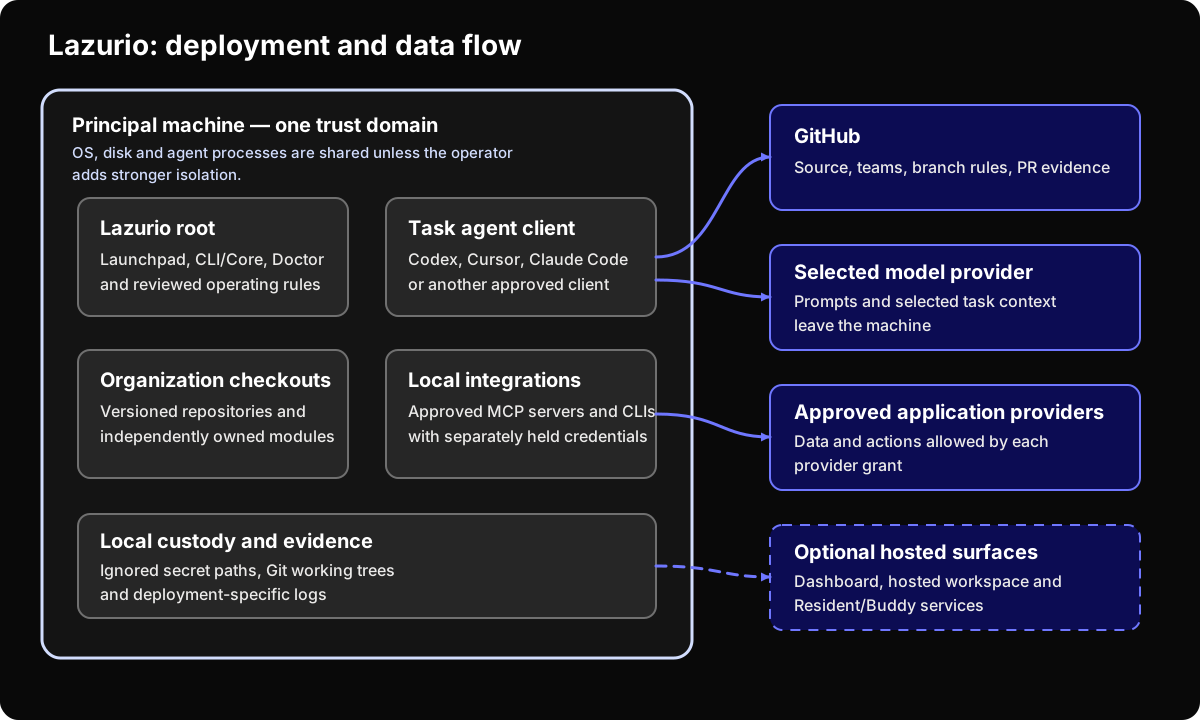
The diagram is a reference model. Optional hosted services are separate services and belong in the inventory only when a deployment enables them.
Decision snapshot
Section titled “Decision snapshot”| Item | Current public position |
|---|---|
| Product form | Developer-operated source checkout using Git and Bun. A packaged installation is a future target. |
| Runtime maturity | Launchpad, Doctor and selected module flows work today; CLI v0 remains experimental. |
| License | Source-available under FSL-1.1-Apache-2.0, with Apache 2.0 applying to each published version after two years. |
| Assurance | No certification, universal service level, retention period or deployment topology is claimed. Support and hosting terms belong to the concrete deployment. |
See security and control evidence for the license, source links and limits of these claims.
The short version
Section titled “The short version”| Area | Lazurio’s operating model | What IT should verify |
|---|---|---|
| Identity | The signed-in principal supplies authority; a task agent has no independent rights. | The account, repository membership and machine owner are correct. |
| Company boundary | One company maps to one Organization and GitHub access boundary. One machine remains one trust domain. | Only intended repositories are mounted; use separate machines or equivalent isolation when companies must not share an OS boundary. |
| Working context | Work begins in checked-out source and explicitly enabled tools. | Endpoint protection, local data scope and provider terms meet policy. |
| Publication | Agent output stays editable until an authorized merge, deployment, send or provider action. | Branch rules, reviews and provider permissions enforce the intended gate. |
| Integrations | Connections are locally curated and separately revocable; official MCP or CLI paths are preferred. | Every provider, OAuth scope, owner, data path and revocation procedure is accepted. |
| Evidence | Git and provider records can show who changed what, but coverage depends on the tools actually used. | Required endpoint, model, app and deployment logs exist and have named retention. |
What data can be reached?
Section titled “What data can be reached?”Access depends on the account, machine, repository permissions, AI client and enabled tools. Check these five areas for your deployment:
- Git repositories and teams visible to the operating identity.
- Local files placed inside the active workspace or readable by the client.
- External applications enabled through an approved MCP server, CLI or browser workflow.
- The agent client, model provider and any hosting provider used by modules.
- Optional hosted Lazurio services such as Dashboard, a hosted team workspace or a per-owner Resident/Buddy service.
An integration existing in the ecosystem is not evidence that it is enabled. Ask for a live list with provider, scopes, owner and revocation instructions.
Where enforcement lives
Section titled “Where enforcement lives”Lazurio does not turn policy prose into a universal technical restriction. Controls remain with the system that owns the capability:
| Action | Effective control |
|---|---|
| Read a local file | OS permissions, workspace selection and any client sandbox. A readable file may be sent to the model provider as task context. |
| Push a branch or open a pull request | GitHub write permission. This is reviewable Draft work, but the source has already reached GitHub. |
| Merge or deploy an exact revision | Branch rules, required checks, reviews, merge rights and the module’s deployment gate. |
| Create or send something in an external provider | That provider’s credential, scopes and confirmations. A provider draft may already transmit data; where no provider-enforced restriction exists, explicit authorization remains a process control. |
In plain language, an Agent can prepare a proposed change, but making it effective still depends on both the signed-in account and the person responsible for the exact decision.

Minimum approval package
Section titled “Minimum approval package”Before production use, ask for:
- the Organization, repository and enabled-service inventory;
- named identities, GitHub team grants and offboarding owners;
- the endpoint protection and local-data baseline;
- the selected agent client, model provider and data-processing terms;
- integration scopes, credential custody and revocation procedures;
- branch protection and provider-specific publication authority;
- logs, retention, backup, deletion, incident response and rollback; and
- a bounded pilot that proves both the normal path and meaningful denials.
Unknowns should become implementation issues, not security claims.
Suggested decision
Section titled “Suggested decision”Approve a scoped pilot when the identities, repositories, endpoint boundary, providers, integrations and action-by-action gates are concrete and testable. A source-checkout pilot carries different support and change-control risk from a managed product. Continue with data access and security and deployment and operations before approving production use.